
Here are some of the best Rhodes plugins I found that actually deliver authentic tine and reed character without choking your system or forcing you to spend hours building effects chains just to get usable tones. The difference between a great Rhodes plugin and one that sits unused in your plugin folder isn’t just about sampling depth or modeling accuracy, it’s about whether the instrument responds like real hardware when you dig in, sits naturally in dense mixes without fighting for space, and loads fast enough to capture ideas before they disappear.
In 2026, the plugin brands understand that producers need tools that finish tracks, not just sound impressive in solo. That means continuous dynamic response that feels connected to your playing instead of obvious velocity switching, built-in effects chains that get you from raw instrument to radio-ready tone in minutes, and enough control over mechanical behavior, pickup characteristics, and amp simulation to dial in everything from clean pop chords to gritty indie hooks without loading five separate plugins.
Whether you’re tracking neo-soul keys in Atlanta, cutting pop demos in LA, building worship pads in Nashville, producing lo-fi beats in a bedroom studio or anything between, here are few plugins I will talk about that actually works: Rhodes V8, UJAM Virtual Pianist GRIT, Arturia Stage-73 V, UAD Electra 88, then few more paid options as well as three killer free options. Let’s get started:
1. Rhodes V8 by Rhodes Music
If you’re tired of Rhodes plugins that sound close enough but fall apart the moment you play anything beyond basic block chords or simple sustains, you need an instrument built on the actual source rather than someone’s best guess at what a Rhodes should be.
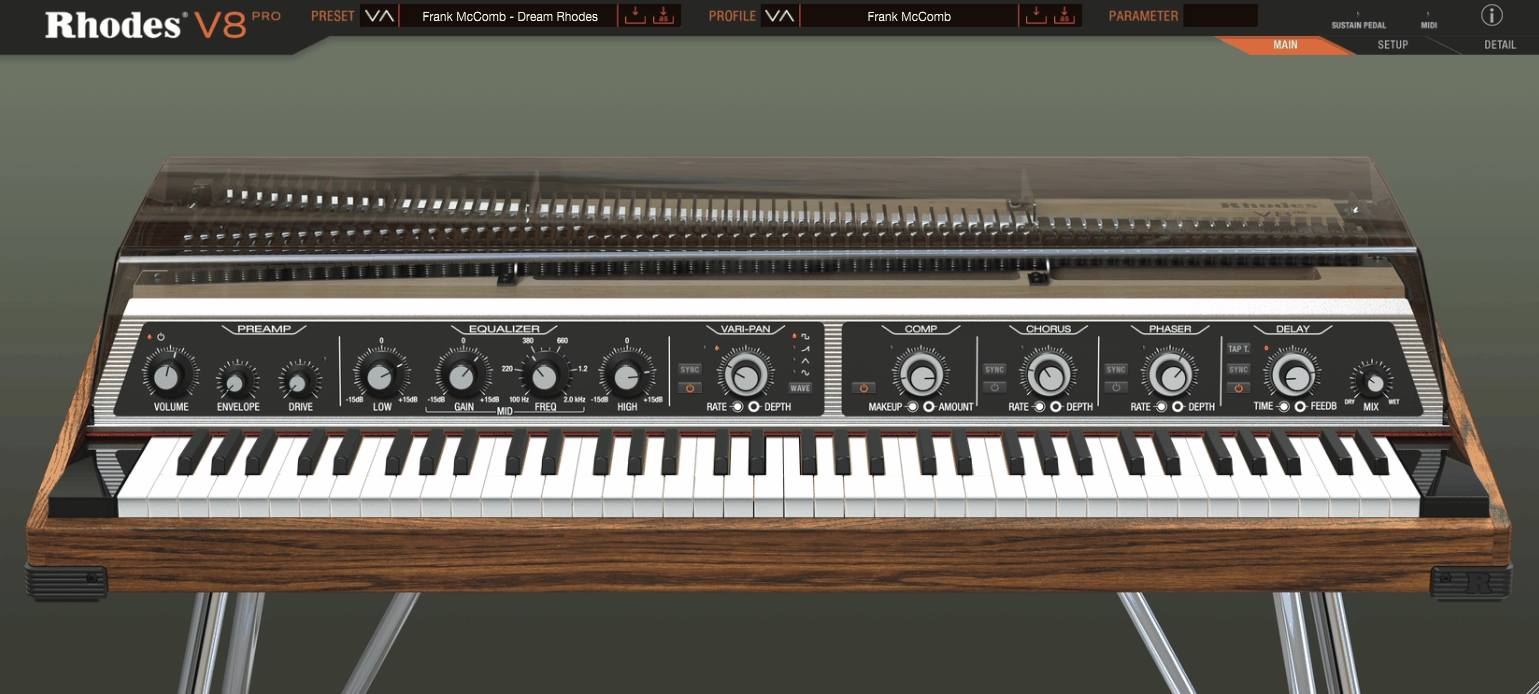
Rhodes V8 plugin is the official MK8-based virtual instrument, designed as a hyper-realistic recreation using 30,000 samples recorded at 96kHz/24-bit, with up to 127 velocity layers per key and 14 articulations that include sympathetic resonances and mechanical noises. To me, what separates V8 from generic EP libraries is that it’s built to respond like the actual instrument, not just trigger nice recordings.
The realism isn’t just about sounding pretty on a single velocity layer, it’s about holding up when you play real parts: left-hand comping, right-hand runs, repeated-note grooves, and the kind of expressive touch changes that make or break an EP in modern R&B, indie, gospel, and pop. The result is a plugin that doesn’t collapse into obvious sample repetition or stiff dynamics when you’re performing.
- Sample Depth That Matters
Most Rhodes plugins give you a few velocity layers and hope you don’t notice the gaps when you play dynamically. When it comes to Rhodes V8, it takes a different approach by capturing up to 127 velocity layers per key, which means the instrument responds continuously across your entire dynamic range rather than jumping between a handful of obvious trigger points.
- MK8-Style Preamp Controls
The Main View is where V8 becomes production-ready without needing a pile of extra inserts. This is the broad tone-shaping layer modeled on the MK8-style preamp board, and it includes the essentials: Drive, Low/High EQ, and the signature Vari-Pan with Rate and Depth controls.
I find the Drive control particularly useful because a lot of real Rhodes character is actually preamp behavior, especially for those slightly pushed, saturated tones that sit forward in modern pop and indie productions without sounding overly aggressive. The Low/High EQ is musical and fast, meaning you can dial body or brightness without second-guessing whether you’re EQ’ing yourself into a corner tonally.
Also, Vari-Pan is not just tremolo, it’s a stereo movement tool that can turn a basic Rhodes part into a wide, animated hook that reads on earbuds, car speakers, and club systems without you having to overdo chorus or reach for a separate modulation chain. For instance, when you’re working on a verse where the Rhodes needs to sit tight and centered, you can dial back the movement, then open it up for the chorus to create instant width and energy without changing the part itself.
- Presets and Profiles
Rhodes V8 includes 72 factory presets and 72 factory profiles, and the Pro version adds artist content on top of that foundation. I think the distinction between presets and profiles is worth understanding because it reflects how Rhodes approaches the instrument as a performance tool rather than just a preset browser.
Presets give you complete album-ready sounds with all processing applied, while profiles focus on tonal character and mic/amp settings without baking in heavy effects, which means you can start from a solid foundation and build your own processing chain when you need more control. Personally, I like how this two-tier approach lets you work fast when you need immediate results but doesn’t lock you into someone else’s FX decisions when you’re building a specific production sound.
- Per-Note Control and Setup
Rhodes splits the deep control into more advanced pages, and the Setup page is where you can really dial the instrument to match specific needs. The Setup page offers per-note control over Timbre, Fine Tune, Level, and Damper response, and you can also tweak mic and amp settings.
The Pro version provides note-level tweaking, which is the difference between great Rhodes tone and the ability to dial in the exact keybed behavior and harmonic profile on specific notes like a tech would adjust on a real instrument. I would say if you’re working on film scoring, where you might need to match a specific vintage Rhodes sound from a reference track this per-note control becomes essential rather than just a nice to have feature.
That being said, the standard version gives you plenty of control for most production scenarios, so the Pro upgrade is really about whether you need that extra layer of customization or plan to use the artist presets that come with it.
- Built-In Effects Chain
The Rhodes sound on records is rarely dry DI. It’s preamp tone, movement, and classic modulation working together as a cohesive instrument. Rhodes V8 Pro models the MK8 FX board and includes a VCA modeled compressor, 4-stage stereo phaser, bucket-brigade modeled delay, and stereo chorus, plus mic/amp/cab simulation.
In practical terms, you can get that album Rhodes sheen and width inside the instrument without reaching for a separate pedalboard chain every time. The phaser especially is a core element of the classic Rhodes sound, and having it modeled correctly inside the plugin means you’re not hunting for third-party effects that might or might not capture the right vibe.
- Why It Belongs Here
To me, Rhodes V8 earns a spot because it’s built on 30,000 samples, up to 127 velocity layers, 14 articulations, and detailed realism elements like sympathetic resonance and mechanical noise, with a mix-ready front end that includes Drive, EQ, and Vari-Pan, plus a deeper layer of control that’s aimed at musicians who actually care about how the instrument plays, not just how it sounds in a loop.
2. UJAM Virtual Pianist GRIT
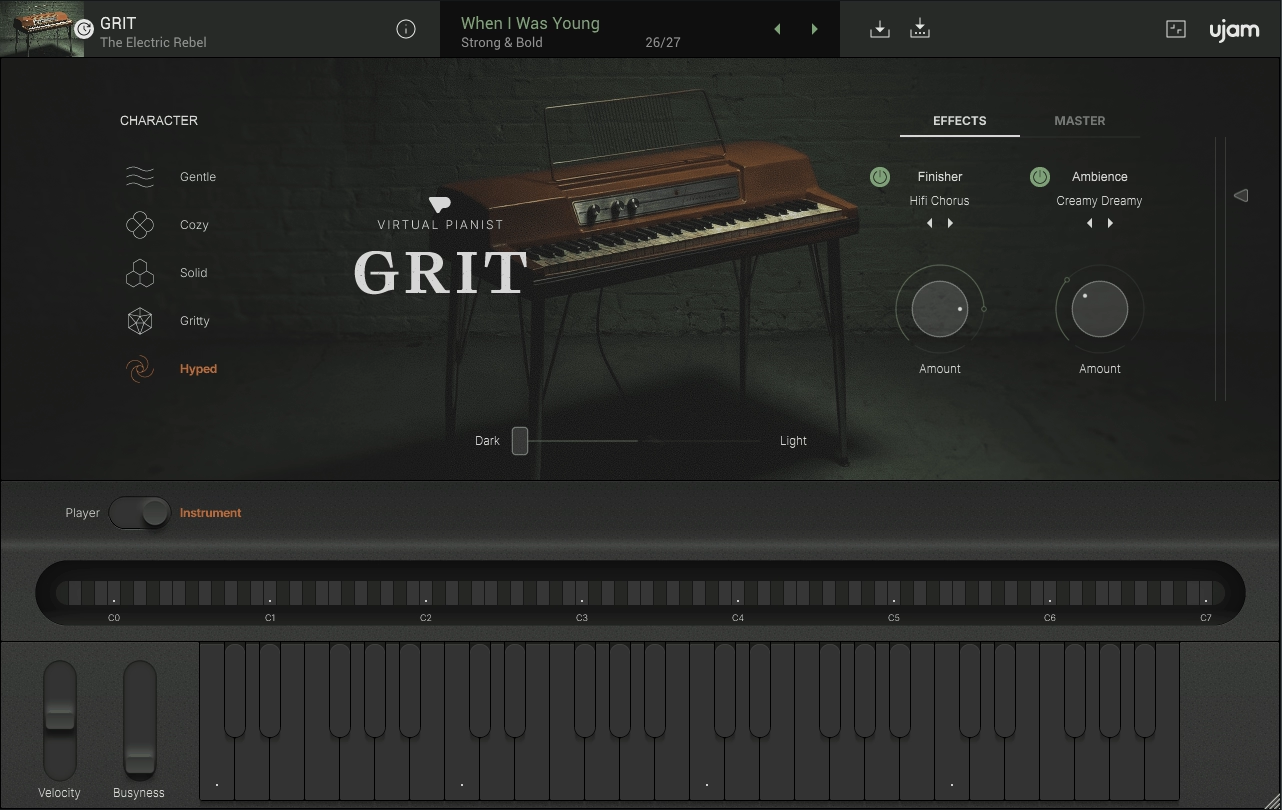
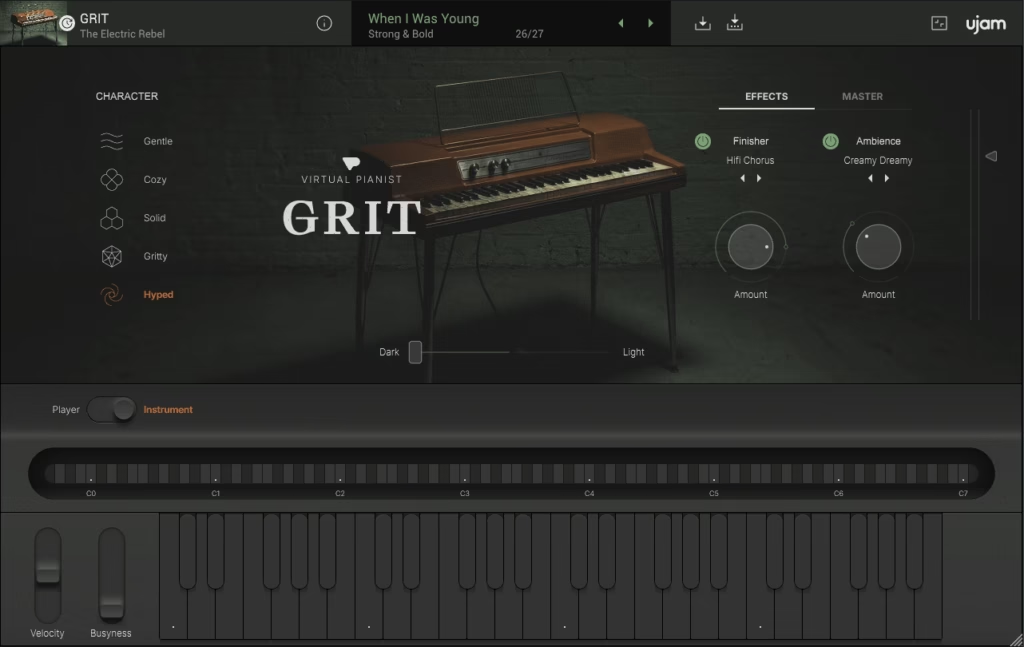
UJAM Virtual Pianist GRIT is not an electric piano you play like a traditional Rhodes plugin, it’s a performance-driven electric piano built for instant, track-ready parts where you play chords and triggers, and GRIT generates realistic rhythmic performances with style, timing, and articulation baked in.
If you’re tired of electric piano plugins that give you a beautiful sound but then leave you staring at a blank MIDI editor wondering what to actually play, or if you need EP parts that sound like a session player cut them but you don’t have the keyboard chops or the time to program realistic performances, this is a completely different approach. UJAM frames it as a one-of-a-kind electric piano with a deliberately rough, characterful tone designed for modern productions.
Here is what you get:
- Played Parts, Not Just Sounds
Unlike traditional EP VSTs where you’re responsible for every nuance, GRIT is centered around performance phrases. It’s part of UJAM’s Virtual Pianist series, which is specifically designed to produce authentic piano performances from simple input.
I think that means GRIT is best when you want right-hand rhythms, chord voicings, and groove feel that sound like a human played them, without you needing to be a keys player or spend an hour programming MIDI.
For instance, when you’re producing a pop track and need the EP to lock with the drums in a way that feels natural rather than quantized, GRIT handles that automatically based on the style and phrase you choose.
The workflow is simple: you play chords in your left hand, trigger phrases with your right hand, and GRIT generates the performance with proper timing variations, dynamics, and articulation that would take hours to program manually. That being said, this approach does mean you’re working within UJAM’s phrase system rather than having complete note-by-note control, which is worth knowing if you prefer total creative freedom over speed.
- Gritty EP Character
UJAM explicitly positions GRIT as an electric piano with attitude, more amped and textured than polite and glassy. The tone is described as one-of-a-kind with a deliberately gritty personality.
In practice, it’s the kind of EP tone that works when you want the keys to cut through guitars and drums in a band mix, or when you want a hook layer that reads on AirPods and in the car without needing a ton of external processing. To me, this is crucial for modern production where the EP needs to sit assertively in dense arrangements without getting buried or taking up too much space.
The character lands somewhere between vintage Rhodes bite and modern indie grit, with enough harmonic edge to stay present but not so aggressive that it dominates softer arrangements. I like how this tonal choice makes GRIT immediately useful for rock, indie, and contemporary pop without needing heavy EQ or saturation to find its place in the mix.
- Styles and Phrases Workflow
GRIT is designed around Styles and Phrases, which is UJAM’s standard Virtual Pianist workflow. You pick a style that matches the groove, then trigger phrases with your playing to generate an arrangement.
This is why it’s especially useful for producers who work fast: you can sketch a full verse/chorus EP part in minutes, then swap styles to test whether the track wants more push, more swing, or a different rhythmic density, without rewriting the performance from scratch. I appreciate how this approach lets you focus on the song rather than getting stuck in MIDI programming, which is exactly what you need when clients are expecting finished demos by end of the day.
Each style includes multiple phrase variations, so you’re not just triggering the same pattern repeatedly. You can build verse phrases, chorus intensity, breakdown sections, and fills that all feel connected musically but provide enough variation to keep the part interesting across a full song arrangement.
- Real-World Use Cases
GRIT shines in situations where you need electric piano parts that sound human but you’re not a keyboard player yourself and can’t spend hours crafting perfect performances. It’s mainly built for songwriter sessions, pop-rock tracks, and cue writing.
For instance, if you’re working on a sync placement and need a convincing EP part that grooves with the drums by tomorrow morning, GRIT gets you from idea to finished part faster than traditional EP plugins where you’re building every note manually. I would say this speed advantage becomes essential when you’re juggling multiple projects or working in production environments where turnaround time directly affects your ability to take on more work.
3. Arturia Stage-73 V2
If you’re tired of Rhodes plugins that either sound great but choke your system with massive sample libraries, or run efficiently but feel lifeless and stiff when you actually play them, you need a different technical approach entirely.
Arturia Stage-73 V2 is built around physical modeling that generates the sound in real time, which means you’re getting authentic Rhodes-style electro-mechanical behavior without dealing with huge sample pools that eat up drive space and load time. The whole pitch is real tine, tone bar, and pickup physics you can push from clean bell to barking midrange bite, with enough control to make it feel right on your controller whether you’re tracking at home or cutting keys for a pop session.
I think this is exactly the kind of plugin working producers need when they want the classic Rhodes vibe without the overhead that comes with deeply sampled instruments, and without sacrificing the organic response that makes an EP feel like hardware instead of a preset machine.
- Stage and Suitcase Models
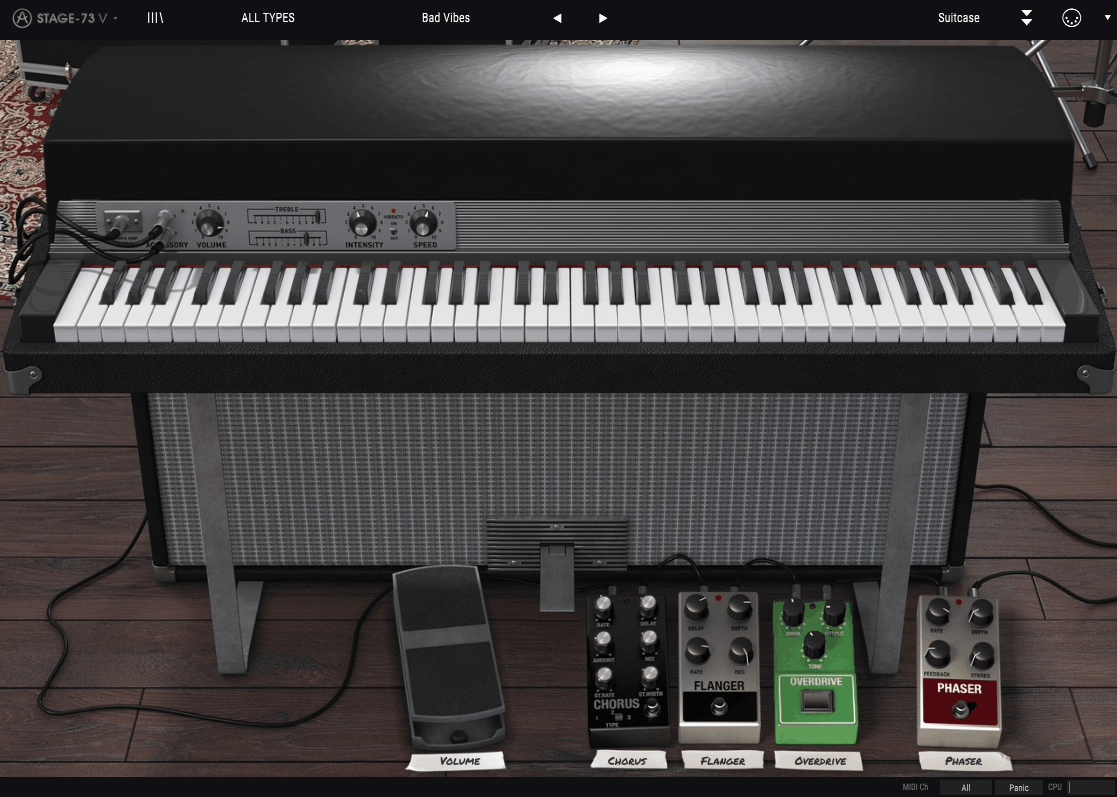
Stage-73 V2 gives you two keyboard models: Stage and Suitcase, and they’re not interchangeable clones. The Stage model is the more direct instrument side, while the Suitcase model brings the full rig behavior, including the classic stereo movement vibe that makes Rhodes parts feel wide and alive in a mix.
On the Stage model, Arturia explicitly includes ’73 and ’74 tone circuit behaviors, with a Tone knob that controls brightness for the ’73 model. I think that’s the kind of small but real detail that matters when you’re chasing a specific record feel: darker, rounder comping for R&B verses versus brighter, cutting attack for chorus stabs.
The Suitcase model includes a modeled preamp, bass/treble EQ, and stereo vibrato with adjustable speed and intensity. That stereo vibrato is a big part of why Suitcase Rhodes tones feel wide and alive in a track, especially in headphones and on car speakers, where a static EP can feel flat unless you add motion. To me, this is crucial for modern productions where the Rhodes needs to sit in dense arrangements without getting lost or taking up too much space.
- Physical Modeling Depth
Where Stage-73 V2 earns its keep is the amount of mechanical and electro-magnetic detail you can manipulate. The modeling includes parameters like tuning, tine angle, tone bar, pickup, plus performance realism elements like hammer noise, damper noise, and dynamics.
I like how this approach means you’re never locked into pre-recorded behaviors. The instrument responds continuously to how you play it, which becomes obvious when you’re riding dynamics through a verse, making sudden attack changes, or playing fast runs where sampled instruments start revealing their loop points and velocity jumps.
For instance, when you need to match a specific vintage Rhodes character from a reference track, you can adjust tine angle and tone bar settings to shift the harmonic profile rather than hoping a preset gets close enough. That being said, this level of control does mean you need to invest time learning what these parameters actually do, which is worth knowing if you prefer instant-gratification preset browsing over deeper sound design.
- Voicing Profiles
Instead of forcing you to build every Rhodes tone from scratch,V2 includes seven voicing profiles with different characteristics. I think it matters in real sessions because most producers don’t need a Rhodes but rather specific Rhodes role that is tighter and glassy for pop, thicker and wooly for lo-fi/indie, more aggressive for rock, and so on.
The profile approach is basically choose the lane first, then tweak the details, which is exactly what you want when you’re working on tight deadlines or jumping between genres in the same session. You can start from a profile that gets you 80% there, then use the physical modeling parameters to dial in the final character without building the entire sound from zero.
- Effects and Amp Chain
V2 isn’t dry instrument only. It’s built to behave like a Rhodes chain you’d actually run in a studio workflow: 4-slot pedalboard with 13 effects including phaser, chorus, delay, distortion, and tape echo, plus amp simulation with selectable Fender Twin or Leslie Rotary and configurable room ambience.
This is crucial because the Rhodes on records sound is often Rhodes plus phaser or Rhodes plus amp drive or Rhodes plus tape-ish delay, not a bone-dry DI.
The phaser especially is a core element of the classic Rhodes sound, and having it modeled correctly inside the plugin means you’re not hunting for third-party effects that might or might not capture the right vibe. I find the amp simulation particularly useful for adding grit and presence without needing external saturation, which matters when you want the Rhodes to push forward in a rock or indie mix without sounding overly processed.
- What Changed in V2
There’s a very real chunk of users who disliked earlier versions, describing the original Stage-73 as sounding small, lifeless, and cold. But V2 is meaningfully improved, with users directly noting it’s more detailed and responsive than the first version.
The honest framing is this: if someone’s opinion is based on older builds, it’s not necessarily representative of how V2 feels now. I would say the improvements are significant enough that it’s worth giving V2 a fresh evaluation even if you tried and disliked the original, because the modeling engine and tone generation are substantially different from what shipped initially.
4. UAD Electra 88 Vintage Keyboard Studio
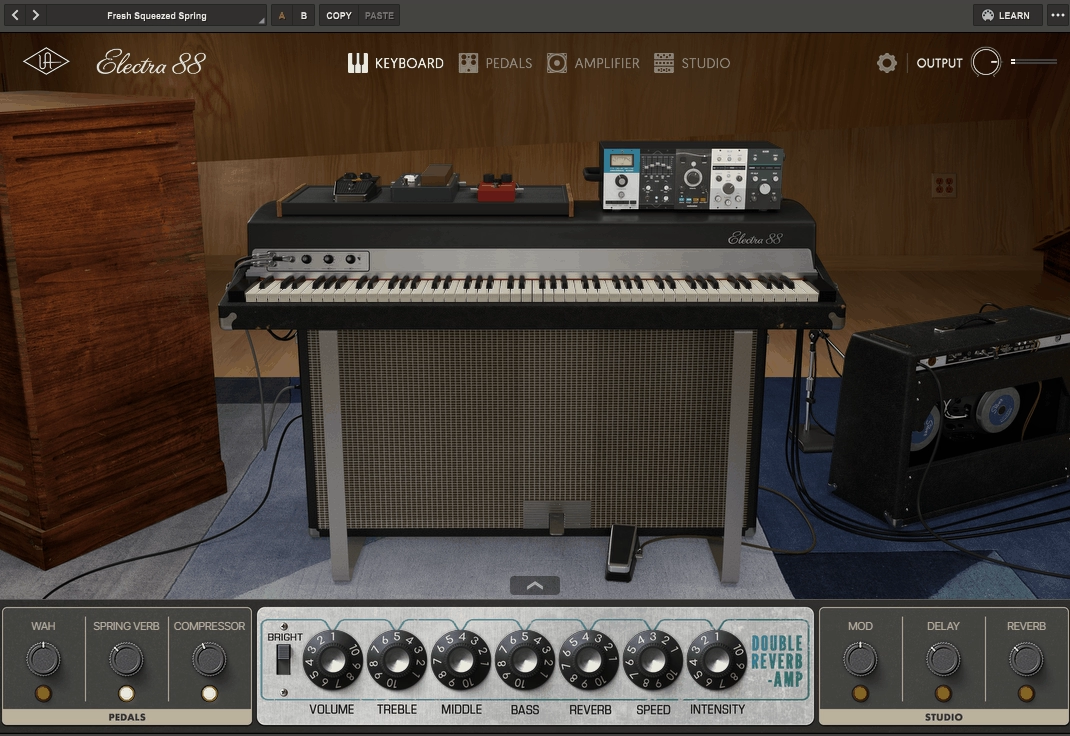
If you’re tired of Rhodes plugins that sound great in solo but then require you to spend an hour building a chain of external effects, compression, and amp simulation just to make them sit in a mix like the Rhodes parts you hear on actual records, you need a different approach.
UAD Electra 88 Keyboard Piano is built around one central promise: the album-ready sound of a perfectly modeled 1974 Rhodes Eighty Eight Suitcase Mark I, delivered like a full tracking chain where you’d normally be running a Rhodes through pedals, an amp or DI, and then real studio rack processing to make it sit on a record.
I think Universal Audio frames it as a complete vintage keyboard studio rather than a single electric piano patch, and that’s exactly how it behaves in practice. You’re not just loading an instrument, you’re loading an entire signal path designed to get you from idea to finished tone in minutes instead of hours.
- The Core Instrument
At the center is the Rhodes itself, and UA’s description is explicit: Electra 88 gives you the rich timbre of a perfectly modeled 1974 Rhodes Suitcase Mark I with a focus on three-dimensional tone and playability that goes beyond generic electric piano plugins.
The instrument was deep-sampled from a special, hand-picked Fender Rhodes MK1 to capture the full dynamic and tonal response, including the little quirks that make a Rhodes feel like a real object in the room, not a static sample. I think that matters for R&B, neo-soul, indie, gospel, and pop sessions where your right-hand dynamics and repeated-note phrasing are the whole vibe.
For instance, when you’re comping chords underneath a vocal, the way the Rhodes responds to subtle velocity changes is what separates a professional production from a programmed demo. The instrument needs to breathe with you, not just trigger nice recordings at fixed intervals, and that’s where Electra’s modeling depth becomes obvious in real playing situations.
- Pedals That Actually Matter
Electra lets you assign up to three pedals, and the first slot is intentionally specialized: slot one can be either Wah or Fil-tron, while slots two and three can be any other pedal. The pedal roster is exactly the kind of stuff producers actually reach for on Rhodes: Chorus, Compressor, Flanger, Phaser, Spring Verb, and Tape Echo, plus that Fil-tron envelope follower for auto-wah and vowel-like motion.
- Amplifiers and DI Options
Electra includes three amplifiers plus a Direct Box, and each one is meant to do something specific. The Double Reverb is a classic 2×12 American tube combo with grit, tone shaping, built-in spring reverb and tremolo, and it’s designed to overdrive easily because Electra’s preamp output is hotter.
The Suitcase option is the built-in stereo Rhodes-style preamp and 4×12 suitcase cabinet, giving you the classic optical vibrato behavior that makes Rhodes parts feel wide and alive in a mix. The Rotary Type 147 is a classic tube rotary rig, which is perfect for turning a straight Rhodes part into a swirling hook that reads on earbuds, car speakers, and club systems.
- Mics and Speakers
This is where Electra 88 starts feeling like a virtual session. You get multiple speaker options on the American combo and a curated mic locker that covers the classic studio bases. The mic list includes the kinds of voices you’d actually audition on keys amps in a studio: CON 67 tube condenser, DYN 57, DYN 421, RIB 121, CON 87, CON 84, RIB 4038, DYN 20, and a boutique iFET 7.
I can only say the mic choice is often what defines whether a Rhodes part feels intimate or aggressive, close or roomy, polished or raw. For instance, when you need a more distant, roomy perspective for a ballad, you can switch to a ribbon mic and back it off, then swap to a close dynamic for a rock chorus where you need presence and attack.
- Studio Rack Processing
Electra’s studio section is fixed as five rack modules: EQ, 1176 compression, Modulation, Delay, and Reverb. The EQ is a tailored five-band graphic EQ with high-pass and low-pass filters and output gain, designed specifically around the frequency range of the instrument, which is why it’s so fast to carve space around vocals and bass.
The compressor is a simplified but powerful 1176 Rev A blue stripe style section, with Compression amount, Mix for parallel compression, and character buttons that shift behavior from Smooth to Punchy to Fast to full-on Aggro, which is the all-buttons-in saturation and harmonics mode. This is the kind of make it radio-ready compression behavior people associate with finished records, not just polite leveling.
- Performance and Realism Controls
Electra doesn’t stop at tone and FX. The settings include musical realism controls that directly change how it feels under your hands. There are tuning conditions that move from New to Vintage to Worn, and a Stretch tuning option that’s genuinely practical when you’re layering with other stretch-tuned instruments.
5. Waves Electric 200 Piano
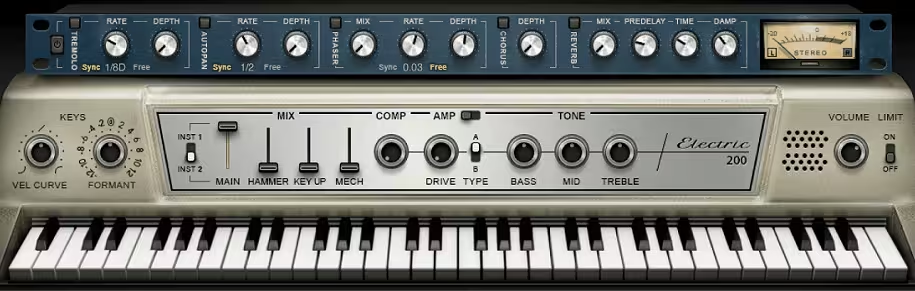
If you’re looking for a Wurlitzer plugin that captures the punchy reed bite and warm midrange growl you hear on classic records without the guesswork or massive sample libraries, you need an instrument built from carefully sampled source hardware rather than generic EP synthesis with a filter slapped on it.
When it comes to Waves Electric 200 Piano, it’s Waves’ focused take on the classic Wurlitzer 200-model electric piano sound, positioned as precise sampling of the 200-model, the same family of instrument associated with artists like Stevie Wonder, Marvin Gaye, and Queen. I think this plugin is very much about getting you from dry Wurli to finished track fast, the way you’d actually want it when producing at home or cutting keys for sessions where time is money and clients expect radio-ready tones immediately.
The difference between a convincing Wurli part and a generic EP sound often comes down to those little details that cheaper plugins skip: the mechanical action, the reed character variations between different instruments, and the classic effects chain that makes a Wurli sit in a mix without fighting for space.
- Two Distinct Wurlitzers
The defining feature is that Electric 200 isn’t based on a single instrument. Waves is explicit that it samples two distinct 200-model Wurlitzers, each with its own tone and personality. That matters because real Wurlis vary a lot: some are rounder and smoother, others are brighter and raspier, and that difference is a big part of why the best Wurli parts feel human instead of generic.
I think Electric 200 is designed to give you that choice inside one instrument, so you can pick the Wurli that fits the track before you even touch FX. For instance, when you’re working on a ballad that needs warmth and body, you can choose the smoother Wurli, then switch to the brighter one for pop stabs that need to cut through dense arrangements.
- Mechanical Realism
A major part of the real Wurli vibe is the stuff that isn’t the notes: key and hammer noises, mechanical action, and the internal physical behavior that makes the instrument feel present in the room. You can dial in additional sampled internal mechanism sounds like hammer and key noises, and this contributes to the feeling that your MIDI controller is closer to the real instrument rather than a clean synth patch.
In practice, this is huge for R&B and indie productions where the electric piano often sits right under the vocal and you want that subtle hands-on keys intimacy. To me, these details are what separate professional Wurli tones from placeholder sounds that get replaced later.
I like how the mechanical noise isn’t just baked in at one level, you can actually control how much you want. When you’re building a lo-fi track where you want the Wurli to feel worn and lived-in, you can push the mechanical character for that vintage authenticity. When you need a cleaner, more polished sound for pop or soul productions, you can dial it back so the note clarity stays intact.
- Tone Shaping and Production Chain
Electric 200 is not meant to be a barebones sample player. It comes with effects, compressor, and amp built in, which is exactly how most engineers treat a Wurli when tracking: you shape it through a chain so it lands in the mix immediately, not later.
The instrument interface is very production-forward, with modules for classic 70s-style effects and broader shaping rather than endless hidden menus. I appreciate how that’s why it’s a strong pick for producers who want a Wurli to sit right next to drums and bass without spending an hour building a pedalboard from scratch.
- Tremolo and Movement
The real Electric 200 sound in records is rarely static. Wurli parts often lean on tremolo, and Electric 200 is designed to let you get that movement quickly, plus additional period-correct treatment. The top section is where you create and control effects including tremolo along with other widening and vibe options.
The key is that these effects are meant to feel native to the instrument rather than like bolted-on inserts, which helps when you’re building parts that need to groove. For instance, think classic stabs in a funk pocket, or long tremolo pads behind a chorus that still read clearly in modern playback systems.
- User Feedback and Real-World Feel
A lot of user feedback centers on one simple reaction: that sound. Users describe Electric 200 as immediately nailing the recognizable Wurli identity, praising both the preset quality and the ability to steer it between vintage and modern tones with the controls.
The same reviews repeatedly highlight the mechanical/noise realism as an inspiration factor, because it makes the instrument feel alive rather than sterile. That’s a big deal for workflows where electric piano parts are often written fast during sessions: if the sound inspires you instantly, you get better parts, faster.
6. Arturia Wurli V
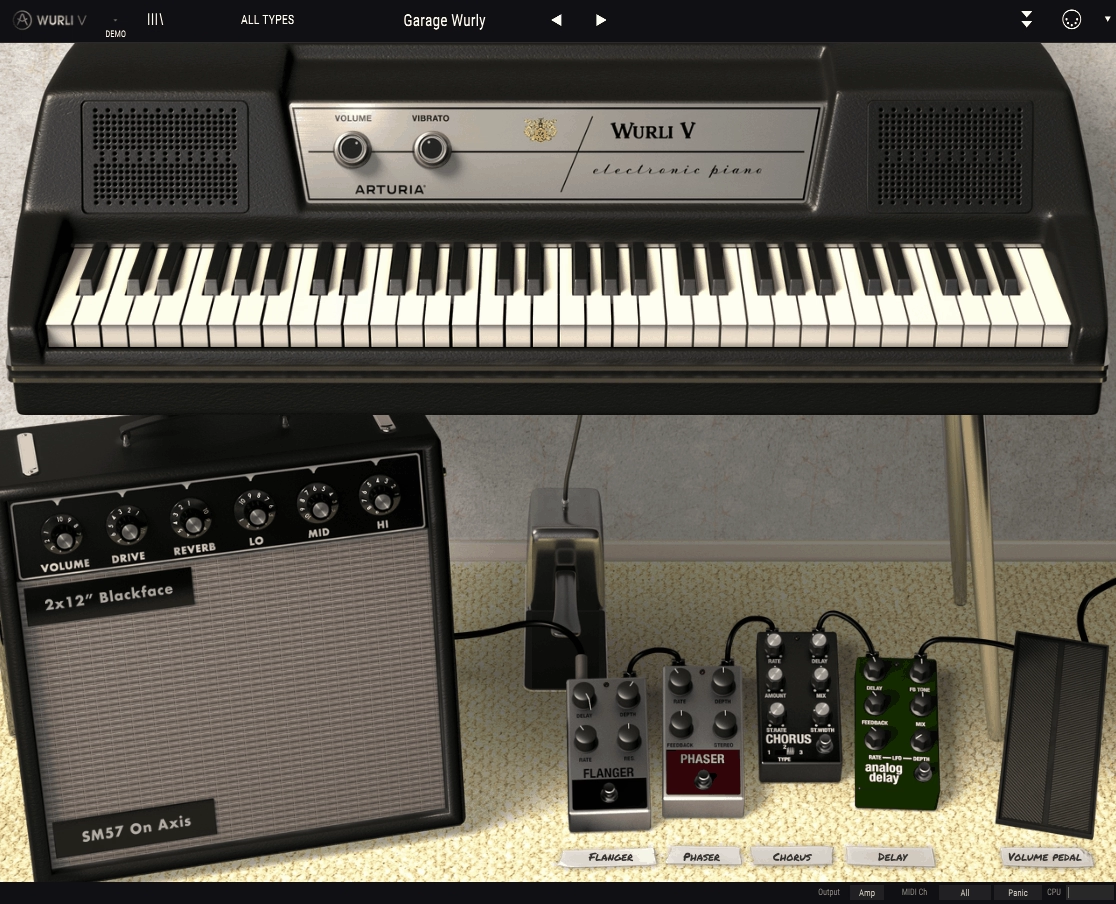
Arturia Wurli V uses physical modeling built on their Phi modeling engine, which recreates the instrument at the component level: reeds, pickups, preamp, and output circuit are generated in real time instead of being stitched together from static recordings.
I mean the practical upside is that it responds like an electro-mechanical instrument when you lean into it: soft, warm, and woody at low velocity, then gravelly and biting when you dig in, which is exactly the sound you want for R&B, gospel keys, indie pop, classic rock, and modern band-in-a-room productions. The modeling approach means you never hit a ceiling where the instrument stops responding because you’ve run out of velocity layers or round robins.
- The Core Sound
A real Wurli is all about midrange character and how it breaks up when you play harder. Wurli V is designed to capture that alive behavior by modeling the physical system, so the tone isn’t just EQ changes with velocity, it’s the instrument reacting: attack bite, harmonics, and the slightly raw edge you hear on classic records.
I think the model is strong enough that the smaller realism details like noise and note-off behavior actually matter, because the core tone is already believable. For instance, when you’re comping chords underneath a vocal in an R&B track, the way the Wurli responds to your touch dynamics is what makes the part feel human rather than programmed with quantized velocities.
The difference becomes obvious when you’re playing parts that require subtle expression, like soft gospel chords that need to whisper without sounding thin, or aggressive funk stabs that need to bark without sounding harsh. The modeling engine handles these transitions continuously instead of jumping between pre-recorded samples.
- Controls That Change the Instrument
Parameters like hammer noise, note-off noise, and mechanical sustain pedal noise are the stuff that makes the performance feel like a real keybed and action instead of a clean DI keyboard.
- Instrument Flavors
Wurli V is commonly described as modeling the classic Wurlitzer 200A flavor, and modern feature summaries reference multiple model variations including 200/200A and bass variants. The practical value of these model flavors is simple: some tracks want the cleaner, rounder side of a Wurli for chords, while others want the more aggressive bark for hooks and riffs, especially in rock and funk.
I appreciate how this means you’re not locked into one Wurli personality, which matters when you’re producing across genres or working on a project that needs different EP roles in different songs. For instance, you might use the 200A model for warm soul ballads, then switch to a more aggressive variant for indie rock hooks that need to cut through distorted guitars without getting buried.
- Amp and Mic Modeling
This is where Wurli V becomes a real session tool instead of a tone demo. The plugin emphasizes classic amp and microphone models plus stompbox-style effects, which is the exact way Wurlis get used in real studios: you don’t just record a raw Wurli, you shape it through an amp/chain so it sits in the track.
- Effects That Match the Era
The plugin includes everything from grit/overdrive to flanger, delay, and reverb. For Wurli specifically, these are not optional extras: tremolo and modulation are part of the signature sound, and a little drive is often the difference between nice keyboard and that classic Wurli that cuts through guitars.
- Playability and Setup
Modeled electric pianos live and die by response. Wurli V is widely praised as playable, but it rewards proper setup. If your velocity curve is off, a modeled Wurli can feel either too polite, never reaching the bark, or too spiky with all bite and no body.
7. AIR Velvet 2
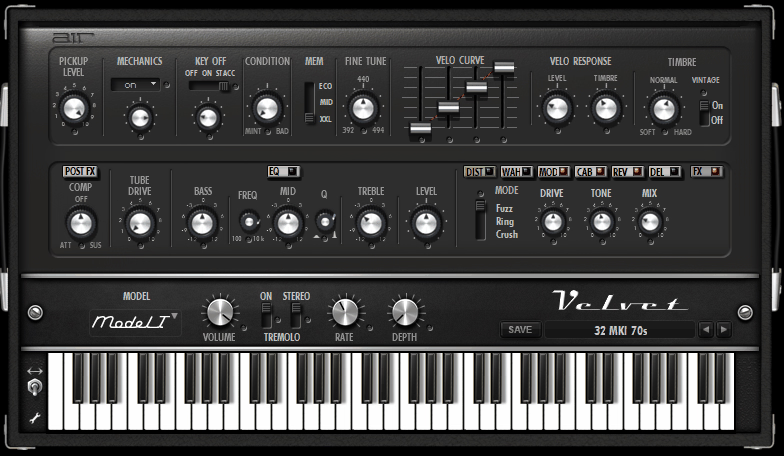
Let’s talk about another plugin from AIR Technology called Velvet 2, that puts five legendary electric pianos inside one instrument, built around the idea that you’d rather switch between models in a single plugin than manage multiple specialized EPs that each take up drive space, CPU overhead, and mental bandwidth. Velvet 2 covers the core classics you actually need: Rhodes Suitcase, Rhodes MK I Stage, Rhodes MK II Stage, Wurlitzer 200A, and Hohner Pianet-T, with a dynamic modeling engine that’s not just a basic sample player, plus a built-in preamp and effects chain so you can get to record-ready tones fast.
I think the entire concept is simple and practical: cover the essential electric piano roles producers reach for in pop sessions, songwriter rooms, church keys rigs, and indie tracking setups without forcing you to own and maintain a library of single-purpose plugins.
- The 5 Modeled Instruments
Velvet 2 is explicitly based on Fender Rhodes Suitcase, Rhodes MK I Stage, Rhodes MK II Stage, Wurlitzer 200A, and Hohner Pianet-T. That lineup is exactly why Velvet 2 still makes sense in a best Rhodes/Wurli/EP plugins list: it covers the big four electric piano roles producers actually use instead of trying to recreate every obscure vintage keyboard ever made.
The Suitcase model is the classic wide, moving, stereo Rhodes lane, especially when you want that swimmy vibrato/tremolo that fills a chorus without stepping on vocals. The MK I tends to be the woody, barky, warm Rhodes for R&B comping and soulful chord work, while MK II usually leans a little cleaner and more controlled for modern tracks where you need the Rhodes to sit politely under other elements.
- Dynamic Modeling and Play Feel
Velvet 2’s engine is positioned as dynamic modeling with a proprietary approach that aims for better dynamic response than a typical ROMpler-style EP. Where this matters is playability: you can tweak timbre, dynamic response, and your velocity curve per model, which is crucial because electric pianos live and die by touch depending on context, and having an EP plugin that adapts to your hardware instead of forcing you to adapt to it makes the difference between inspiring and frustrating.
- Presets
Velvet 2 ships with 350+ presets. That’s great because electric pianos are incredibly context-dependent: one track needs a tight mono MK I that sits under a vocal, another needs a wide Suitcase wash for a chorus lift, another needs a gritty Wurli hook that can fight guitars.
- Mechanical Realism
Velvet 2 includes mixable keyboard and pedal noise for mechanical realism. That’s not a gimmick: on Rhodes and Wurli-style parts, subtle mechanical sound helps the EP sit in the track like a real instrument captured in a room instead of a sterile digital recreation.
The key point is control: you can blend that realism in for intimate neo-soul and singer-songwriter productions, or dial it back for tight pop where extra noise can build up fast once you compress and stack layers. To me, this flexibility is what separates professional EP tones from sterile digital sounds that never feel grounded in physical space.
- Preamp Section
Velvet 2’s preamp is a big part of why it’s useful in real-world production workflows. It includes tube overdrive for that crunchy tine/reed saturation, compression to even out spiky transients, and a 3-band EQ with a parametric mid band so you can quickly carve the right EP midrange to sit with vocals and guitars.
This is the stuff you normally end up doing with separate plugins anyway, so having it built in makes Velvet 2 feel more like a complete electric piano channel strip than a raw instrument. I appreciate that you can load the plugin and immediately start shaping it into the track rather than reaching for five inserts before you even have a usable tone.
- Effects Chain
Lastly, Velvet 2 is designed around the reality that most iconic electric piano sounds are processed. It includes authentic staples like tremolo and autopan, plus a wide palette of period-correct effects: distortion, wah/filter, chorus, flanger, phaser, and tape delay.
I like how these aren’t just generic modulation effects, they’re voiced to work with electric piano tones specifically, which means you’re getting movement and character that complements the instrument instead of fighting against it or making it sound overly processed.
8. Waves Electric 88 Piano
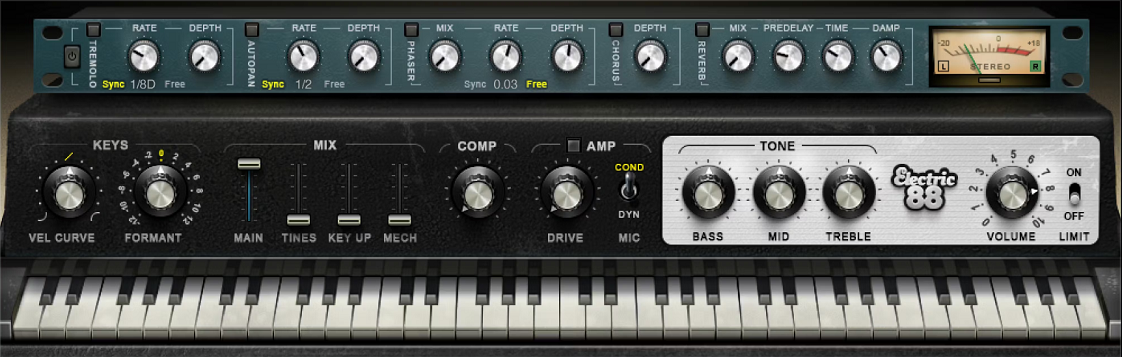
If you’ve been chasing the perfect, pristine Rhodes sound where every note is perfectly in tune, every tine rings identically, and the whole instrument sounds like it just rolled off the factory floor in 1973, you might be chasing the wrong target entirely.
Waves Electric 88 Piano takes the opposite approach by intentionally celebrating imperfection, built around the idea that the most inspiring Rhodes tones come from road-worn instruments that have been gigged, sweated on, and broken in over decades rather than perfectly maintained museum pieces that sound sterile and lifeless.
The core concept is that you’re getting the soul and character of a seasoned 88-key vintage instrument captured with expert multisampling and a faithful velocity response, then shaped inside the plugin with a built-in mix section, tone controls, compressor, amp/cab, and classic modulation FX so it drops into a track the way producers actually use Rhodes in pop, R&B, gospel, indie, and rock sessions.
I think this is exactly what producers need when the Rhodes part needs to feel like it was played on a real, lived-in instrument rather than a pristine showroom EP that’s never been touched by human hands. The reality is that most of the Rhodes sounds you love on classic records came from instruments with quirks, imperfections, and character, not from perfectly maintained studio specimens!
- The Sound Concept
The plugin is explicitly framed as a Rhodes that leans into the character of a road-worn instrument, capturing the keyboard’s signature nuances with a dynamic response that feels convincing under your hands.
In real terms, this is the kind of EP tone that works great in a mix because it already has midrange personality and attitude, so it doesn’t disappear when the track fills up with drums, bass, guitars, and vocals competing for the same frequency space. I like how the imperfections are part of what makes it sit naturally instead of sounding like a perfect digital recreation that feels disconnected from the rest of the track.
For instance, when you’re building a neo-soul or indie production where everything else has organic character and vintage warmth, a perfectly clean Rhodes can actually stick out as too polished rather than blending in naturally. Electric 88 solves that by starting from a place of lived-in character instead of forcing you to add imperfections through external processing.
- Compressor and Amp/Cab
Electric 88 isn’t just DI Rhodes waiting for you to build a processing chain. It includes a vintage-style compressor and a sampled amplified cabinet captured with both a condenser and a dynamic mic, which is exactly the kind of decision you’d make in a real studio: DI clarity versus amp grit, condenser detail versus dynamic punch, and compression to lock it into the pocket.
The workflow is clear: the top module handles effects like tremolo/phasing/stereo/chorus/reverb, and the bottom module handles keyboard and amplifier characteristics. This structure makes it easy to dial record tone fast, whether you’re going for mellow jazz/R&B or a driven rock riff that needs to cut through distorted guitars.
- Built-In Effects
Electric 88 includes the core effects people actually use on Rhodes sounds: tremolo, autopan, phaser, chorus, reverb, plus stereo imaging controls. This matters because the most iconic Rhodes parts on records are rarely bone-dry: tremolo/autopan gives motion, phaser gives that unmistakable vintage swirl, chorus widens, and reverb places it in the track.
- Why I think It Belongs Here
Waves Electric 88 earns its spot because it delivers a Rhodes-style electric piano that feels seasoned, vibey, and record-ready, the kind of EP that works in pop, R&B, gospel, indie, and rock without fighting the mix. You’re getting road-worn character, non-linear sampling for organic dynamics, a hands-on Mix section, creative Formant control, plus the full chain: tone shaping, vintage compressor, amp/cab with condenser plus dynamic mic capture, and classic FX including tremolo, autopan, phaser, chorus, and reverb, all designed to drop into real sessions and sound like it belongs on the record immediately.
I think it’s the kind of Rhodes plugin that becomes essential when you value character and lived-in feel over pristine perfection, and when you need an instrument that inspires rather than requiring extensive processing to sound real.
9. AudioThing Wurly
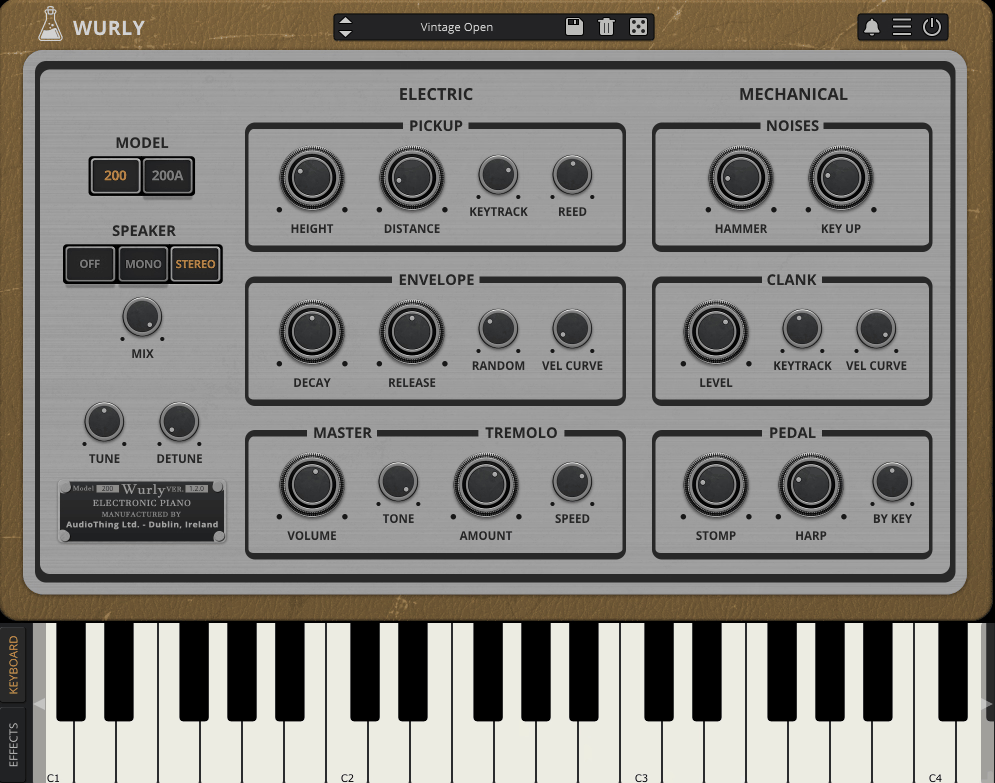
AudioThing Wurly uses hybrid approach of physical modeling plus samples, where the electric tone generation is physically modeled for continuous dynamic response, while mechanical realism is refined with modeling plus high-quality sampled components.
That hybrid design is why it feels both responsive under the fingers and textured in the mix, like the kind of Wurli you’d track in a professional studio or a church keys rig that needs to cut through the band without sounding sterile or overly polished.
- Two Instruments: 200 and 200A
Wurly includes two classic models: the Wurlitzer 200 and 200A, which is not a minor detail because those instruments can behave differently in tone, shielding/noise behavior, action feel, and speaker character. The 200 is positioned as the classic design and the 200A as the refined update, and the plugin lets you switch between them as a core part of the workflow rather than hiding them behind preset marketing.
I can say it gives you you tonal flexibility within the same plugin, because some tracks want the slightly rawer, more aggressive character of the 200, while others need the cleaner, more refined response of the 200A that sits more politely in modern pop productions. For instance, when you’re building a vintage funk track, you might reach for the 200 for that extra grit and character, then switch to the 200A for a contemporary R&B ballad where the Wurli needs to sit under a vocal without competing for space.
- Modeled Pickup and Reed Geometry
The electric part of Wurly is where AudioThing gets unusually nerdy in a good way. The pickup and reed geometry are precisely modeled, and you get direct parameters that actually change the instrument’s behavior instead of just post-processing the output.
The Pickup section includes Height and Distance controls, where height changes asymmetry and harmonic content and distance affects dynamic response and overall gain, plus Keytrack behavior and a Reed parameter that affects dynamic response across the keyboard. I think these controls matter because they’re the kind of under-the-hood parameters that define how a Wurli actually sounds and feels rather than just surface-level tone shaping.
For instance, when you’re trying to match a specific vintage Wurli sound from a reference track, you can adjust pickup height and distance to shift the harmonic profile and attack character rather than hoping EQ and compression get you there.
- Envelope Realism
Wurly’s envelope section isn’t just ADSR because every plugin needs it. You get Decay, Release, and a really important authenticity knob: Random decay, which intentionally mimics old instruments where decay varies across keys due to reeds being mounted or tensioned inconsistently.
- Speakers and Direct Blend
A big differentiator is the speaker capture. AudioThing carefully sampled the speakers on each model, and you can choose Speakers Off, Mono, or Stereo, then use a Mix control to blend direct versus speaker sound.
This is exactly the real-world move for Wurli tracks: DI-forward for tight pop, more speaker for thicker midrange and authenticity, stereo speakers when you want that wide, live feel that plays great on headphones and in cars.
- Mechanical Realism
This is where Wurly starts feeling like a living instrument instead of a clean ROMpler. You get dedicated controls for Hammer noise and Key Up noise, plus a full Clank section. Clank is defined as the acoustic noise produced when the hammer strikes the reed in a Wurlitzer that’s powered off, and you can control Level, Keytrack, and a Clank Velocity Curve.
10. AAS Lounge Lizard EP-5
If you’ve been managing a growing collection of electric piano plugins where you need one for Rhodes tones, another for Wurli sounds, and maybe a third for experimental textures, only to find yourself constantly swapping instruments mid-session and rebuilding effects chains every time you switch, you’re solving a workflow problem with an inefficient and expensive solution.
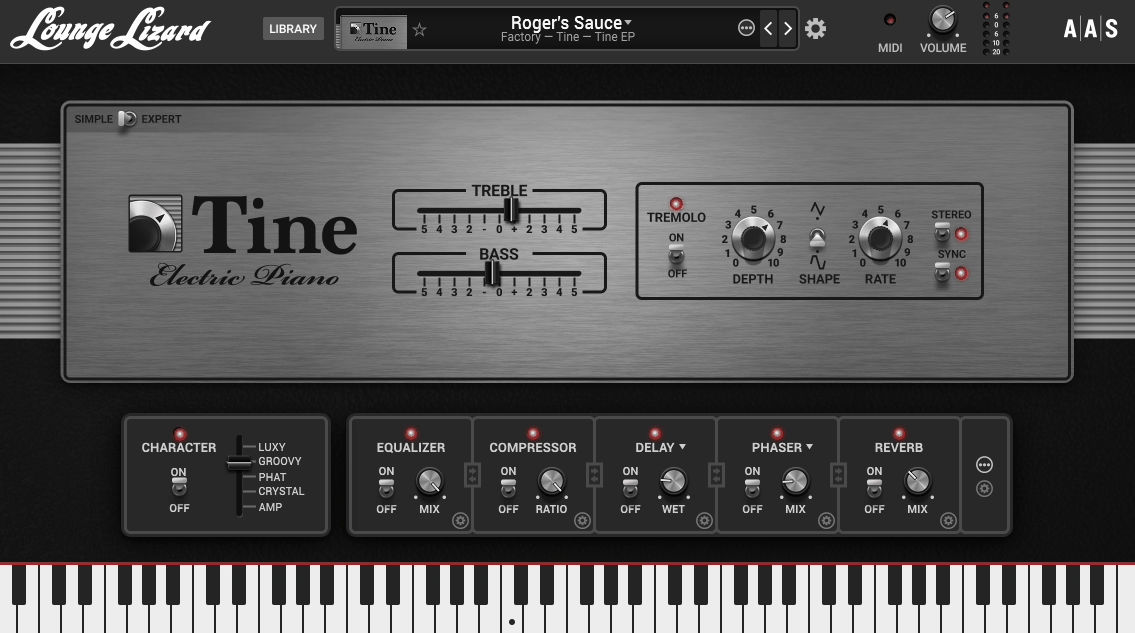
Lounge Lizard EP-5 takes a fundamentally different approach by giving you both tine-based (Rhodes-style) and reed-based (Wurlitzer-style) electric pianos inside one plugin, but here’s the crucial difference: it’s not one compromised engine trying to fake both sounds, it’s two distinct physical-modeling engines, each built specifically for its instrument family. I think EP-5’s big leap is that it’s a complete rewrite with dedicated tine and reed engines, each with its own GUI and key parameters, which means you’re getting authentic behavior for both families instead of one engine that sort-of does everything.
That split is exactly why EP-5 feels more authentic and more controllable than older one-model-fits-all EP plugins. You’re working with purpose-built synthesis engines that understand the actual physics of tines versus reeds, which shows up immediately when you play dynamically or need the instrument to respond naturally to expressive phrasing.
- Dual-Engine Design
AAS calls the upgrade Dual Engine Precision and they’re very specific about what changed: EP-5 now has dedicated models for tine and reed instruments, rather than approximating reeds by twisting a tine model. The architecture is two distinct synthesis engines, one for tines and one for reeds, each with its own interface, and both accessible in Simple or Expert mode, which I will talk about now.
- Simple and Expert Modes
You can use Simple mode for fast results when you’re tracking ideas and Expert mode when you need to get deep into the mechanics and really dial in exactly how the instrument behaves.
- Real-World Performance Feel
Because EP-5 is based on physical modeling rather than samples, you’re getting continuous dynamic response rather than crossfading between velocity layers. This tends to feel more connected to your playing, especially on repeated notes, fast runs, and expressive phrasing where sampled instruments can start showing their seams.
I think this continuous response is part of what separates EP-5 from sample-based alternatives, because the instrument reacts naturally across your entire dynamic range instead of jumping between discrete trigger points that reveal themselves when you play expressively.
- The Sound Library
EP-5 ships with a new library of classic and custom electric pianos, and it’s not just more presets, it’s a refreshed set designed around the new engines. The library includes over 150 electric piano sounds, plus remastered content from the previous version, all accessible through a redesigned browser with search so you can quickly find what you need in a session.
The key point for a best Rhodes/Wurli/EP roundup: EP-5 isn’t only accurate vintage. It’s also meant to go beyond the expected. The instrument can be an accurate electric keyboard and it can imagine new keyboard instrument sounds you haven’t heard before.
That’s exactly the lane for modern producers who want an EP that can be classic on the verse and borderline sound-design on the bridge without changing plugins or breaking the creative flow.
- Built-In Effects Rack
The onboard rack includes the good stuff producers actually use: amp, EQ, compression, modulation, delay, distortion, tremolo, wah/auto-wah, and reverb.
- Why I think it Belongs Here
Lounge Lizard EP-5 earns a spot because it delivers both tine-based and reed-based electric pianos through two dedicated physical-modeling engines, with Simple and Expert modes for fast workflow or deep control, detailed component modeling including hammer, tine/reed, pickup, and damper, over 150 sounds covering classic and experimental territory, and a studio-grade effects rack that gets you to finished tones fast.
I think it’s the kind of EP plugin that becomes essential when you value having both Rhodes and Wurli character in one instrument, need continuous dynamic response that feels connected to your playing, and want the flexibility to go from vintage-accurate to completely experimental without changing plugins.
Freebies:
1. NoiseAsh Sweetcase
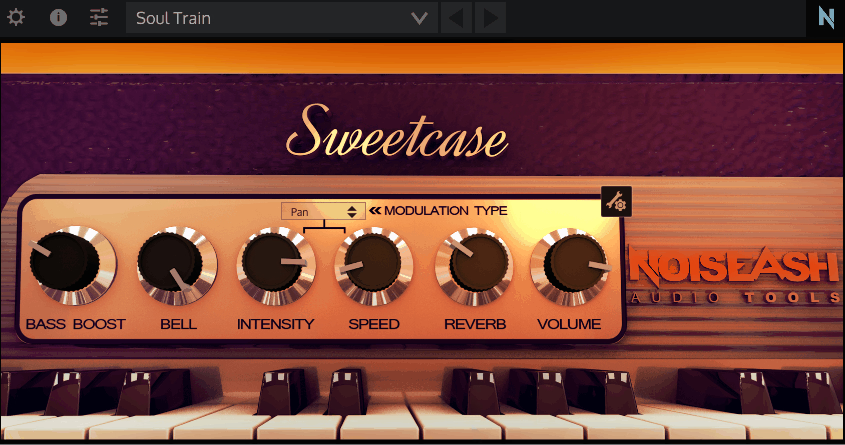
Most free EPs are either stripped-down versions of premium plugins with obvious limitations, or they’re passion projects that sound interesting in isolation but fall apart the moment you try to use them in a real production context. NoiseAsh Sweetcase breaks that pattern by being a free electric piano plugin that doesn’t feel like a demo instrument, and it’s built around a clear target: the classic suitcase-style tine electric piano sound that shows up everywhere in music, from R&B and neo-soul chords to gospel pads, indie-pop hooks, and classic rock comping.
I think the reason it keeps getting recommended is that it’s designed to be mix-ready right away: a focused instrument, a simple control set, and an internal vibe that lands fast in a track without needing a huge insert chain.
The whole approach here is do one thing really well instead of trying to be everything, which is exactly what makes it useful for producers who need a credible suitcase Rhodes tone without spending money on another premium plugin.
- Sound Identity
Sweetcase is explicitly positioned as a vintage electric piano with a suitcase flavor. It’s described as a sample-based instrument designed to deliver that recognizable tine EP character without the bloat or complexity that comes with more ambitious multi-model plugins.
- Core Controls
NoiseAsh keeps the interface intentionally simple, but the controls are the right ones for shaping an EP into a mix. The key front-panel tools are Tone for quick brightness shaping, which is crucial for deciding whether it sits behind the vocal or cuts through guitars, Dynamics/Velocity response style control so it doesn’t feel stiff across different MIDI controllers, and built-in Reverb so you can place it in a room without immediately reaching for external effects.
The practical takeaway is this: Sweetcase is designed for drop it in, play chords, print it workflows. That’s exactly why it’s popular with home-studio producers who want the electric piano to just work in pop, R&B, and worship tracks without extensive sound design sessions.
I appreciate how the Tone control is fast and musical, meaning you can make quick adjustments to match the track context without needing parametric EQ or complex tone shaping. When you’re working on multiple projects in a day, that kind of workflow efficiency matters more than having 50 parameters you’ll never touch.
- Playability
Sweetcase is most convincing on the kind of parts electric pianos are used for constantly: midrange chord voicings, syncopated comping, and sustained beds. Because it’s voiced to be smooth and supportive, it fits especially well when you’re stacking it with pads, guitars, or soft synths in modern productions.
2. Bitsonic Keyzone Classic
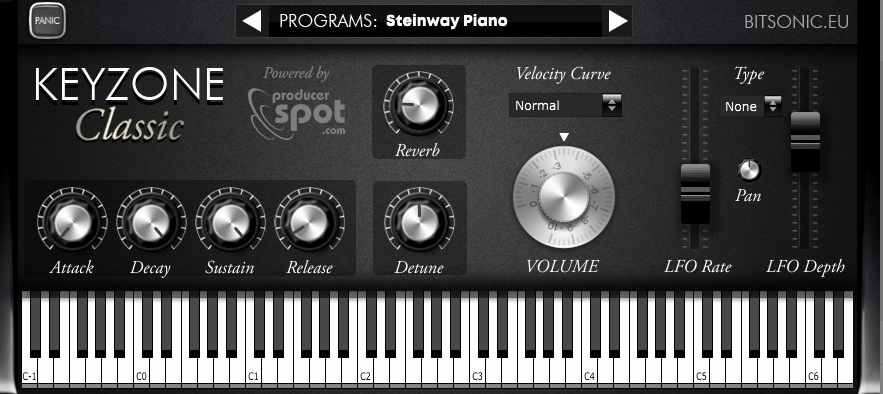
If you’ve tested dozens of free piano plugins only to find they all sound either too synthetic and fake, or so poorly recorded that they’re unusable without extensive processing, the problem isn’t that good free pianos don’t exist, it’s that most developers either oversample to the point of bloat or undersample to the point of uselessness.
Bitsonic Keyzone Classic focused on five carefully chosen, actually usable piano presets instead of trying to give you 50 mediocre options that all need work. It’s still one of the most downloaded free piano plugins for a reason: it’s a simple, sample-based piano instrument that gives you five go-to presets that sit in a mix fast without requiring an hour of tweaking or a pile of external processing.
I think it’s not trying to be a massive, hyper-detailed concert library competing with premium alternatives. It’s the kind of free plugin you keep on your system because when you need a quick piano layer for a beat, a pop chorus, a church keys pad, or a late-night demo session, it gets you there without fuss or frustration.
- Five Presets That Cover Real Production Roles
Keyzone Classic comes with five core instruments: Piano from Keyzone 1, Yamaha Grand Piano, Steinway Grand Piano, Basic Electric Piano, and Rhodes Piano. That set is exactly why Keyzone Classic works: you’ve got two different grand piano flavors for mainstream pop/hip-hop/EDM production, plus a Rhodes-style option for R&B and neo-soul chords, plus a basic EP for sketching.
- How the Presets Behave
The Yamaha Grand Piano is usually the most modern pop friendly patch: cleaner, a little more forward, and typically easier to place under vocals without sounding overly romantic or roomy.
Users describes Keyzone Classic as tight and clear in the lows and generally balanced across the mids and highs, which is exactly what you want when you’re building tracks for earbuds, car speakers, and club playback.
The Steinway Grand Piano is the patch a lot of people treat as the star of the plugin. Reviewers explicitly call the Steinway preset one of the best pianos around, even compared to some commercial libraries, with the common note that a touch of external EQ can make it even more natural. It’s a great choice when you want a slightly more classic grand character for ballads, singer-songwriter parts, or soundtrack-ish chord beds.
With that being said, The Rhodes Piano and Basic Electric Piano aren’t meant to replace a flagship Rhodes instrument, but they’re useful for production. The Rhodes patch is the quick fix for warm chord beds and midrange glue in R&B/lo-fi/indie contexts where you need something that sounds like a Rhodes without needing the perfect Rhodes.
3. DSK Elektrik Keys
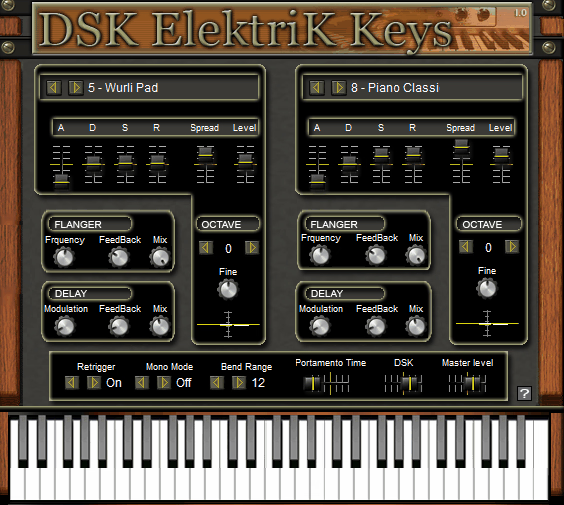
DSK Elektrik Keys is classic grab-and-go electric piano VST that’s stayed popular in home studios for years because it’s simple, lightweight, and gets you usable EP tones fast for beats, pop demos, indie tracks, and songwriting sessions without requiring extensive setup or third-party processing. I think it’s not trying to be a museum-grade Rhodes or Wurli recreation with deep mechanical modeling, and that’s exactly the point: quick, playable electric piano color with a few practical utility tools that help it sit in a mix without a ton of extra work.
The whole philosophy here is utility over obsessive realism, which makes it valuable for producers who need to sketch ideas quickly or finish tracks on deadline rather than spending an hour tweaking parameters just to get started.
- Sound Engine
At the core, Elektrik Keys is built as a 2-layer instrument with 13 waveforms. Think of it like a compact EP module: you blend or stack layers to get a thicker, more record-ready tone than a single static patch would give you.
This is why it can work surprisingly well in busy productions where you need an electric piano to read on AirPods, car speakers, and club playback without disappearing behind drums and bass. I can see that layering approach gives you enough tonal flexibility to cover different EP roles without overwhelming you with options, and the micro-detune control helps thicken the sound when you need the EP to feel wider and more present in the stereo field.
For instance, when you’re building a beat that needs a simple chord progression to sit behind the vocal, you can stack two complementary waveforms and add slight detune to create instant width and character without needing external chorus or doubling plugins.
- Built-In Effects
You get two onboard effects: Delay and Flanger. That’s a small list, but it’s the right list for this style of plugin because those two effects instantly turn a plain EP line into something finished. Delay helps with rhythmic bounce and space in modern pop/hip-hop production, and flanger adds motion and shimmer that can make chords feel wide and alive without reaching for a big pedalboard chain.
I appreciate how these aren’t just generic effects, they’re voiced to work specifically with the electric piano tones in a way that feels musical rather than like random modulation added for the sake of having features. When you need that classic vintage keys territory, the flanger gets you there in seconds, and the delay can turn simple quarter-note stabs into rhythmic hooks that lock with the track without extensive programming.
- Real-World Use
In the end, Elektrik Keys is best when you treat it like a utility electric piano that fills roles quickly. It’s great for chord beds under vocals, simple hook doubles, lo-fi/indie textures, and beatmaking when you need a playable EP part that’s more interesting than a basic sine-key preset but less demanding than a full flagship instrument.
The layering plus micro-detune combo is the fastest way to make it sound bigger, and the built-in delay/flanger can get you into classic vintage keys territory without external processing. I think this is the kind of free plugin that works especially well when you’re sketching ideas, writing demos, or building lo-fi productions where character and vibe matter more than hyper-realistic Rhodes behavior.

Hello, I’m Viliam, I started this audio plugin focused blog to keep you updated on the latest trends, news and everything plugin related. I’ll put the most emphasis on the topics covering best VST, AU and AAX plugins. If you find some great plugin suggestions for us to include on our site, feel free to let me know, so I can take a look!